The accidental baptism in the woods
Die, My LoveThe accidental baptism in the woods is one of the novel's most concentrated expressions of maternal ambivalence, a scene in which the narrator's desperate flight with her infant son into a wilderness that has become a jungle culminates in an act of inadvertent violence that nearly kills the child. It is the moment where the narrator's recurring fantasies of harming her baby — the knife she dreams of, the glass she longs to crash through — briefly become real, and where the sacred language of Christian baptism is twisted into an accident of near-drowning. The scene gathers together the book's central oppositions: the human and the animal, the tame and the murderous, the mother who loves and the mother who destroys.
Flight into the Woods
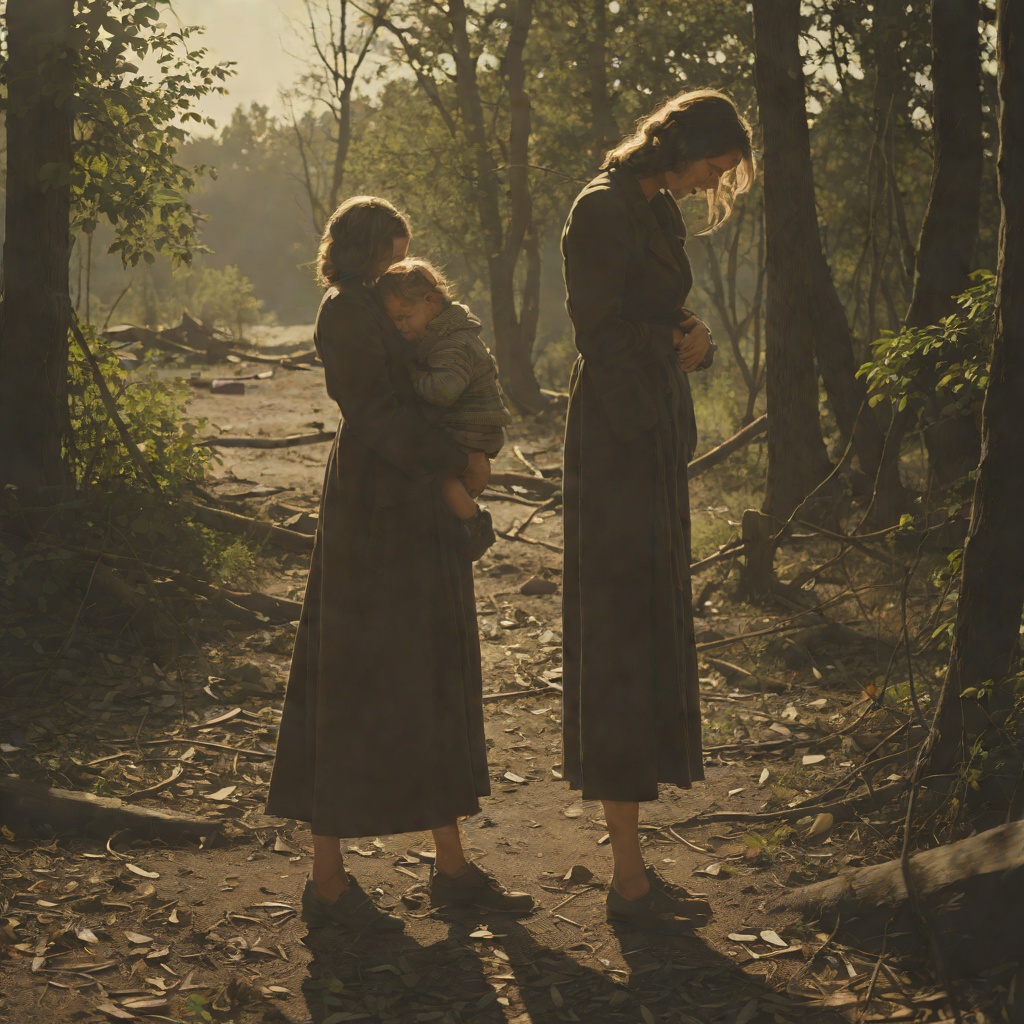
The episode begins as an escape. The narrator ties her baby to her body and the two of them become "a kangaroo and her joey hopping around the field of thorns, bees and wildflowers." They trample the mounds of earth left by subterranean intruders, and she walks over a huge deposit of hundreds, thousands of worms, jumping on them and squishing them with her baby kangaroo. She hurts her ankles hopping towards the thick greenery, ducking to pick ticks off her skin and brush away nettles, bobbing up and down in a funny monkey-like way. When they reach the woods, she unties her baby and lets him walk on the downhill slope. A moment later, she loses sight of him.
Losing and Finding the Child
The loss of the child triggers a panic that is described as something beyond ordinary physical searching. She begins to run, arms flailing, words coming out of her mouth. She hears a gunshot and turns her head furtively, ingenuously, like a faun, pricking up her ears. Her heart beats so fast she thinks she will see him covered in mud among the fallen leaves. Then she starts to look for him "as only a mother can look for her child" — not by running or walking, not through physical actions at all. She finds him lying on some branches higher up than even she would have climbed. He motions to her with his hand and says "Cu-cu ma-ma." He had only just started walking and already he was climbing trees. She thinks she has given birth to a little savage. She scrambles up to where he is and they sit holding on to each other.
The Baptism
From their perch they see the water sweeping across the woods, which are more like a jungle by now. They see the little rabbit skulls and the death of a tiny chick that had got separated from its nest, its mother's sharp black beak wide open in fear. The narrator gives her baby swamp water from the pond to taste, petals from the most colourful and fragrant flowers to eat, leaves to chew on for their sap. They mimic the calls of the animals around them, becoming part of them. The diurnal and nocturnal birds answer them, and they hear the cry that begins peacefully and turns mournful halfway through: the pleasant vowel Aa that changes into the hoarse, fearsome consonant Och. The bird that calls out becomes two birds: sane and insane, tame and murderous. Then she dunks her son in the icy water and baptises him by mistake. "May God forgive me," she says. He seems too pale to be real. He is not a child but a painting, the sketch of a child, the archetype. He has begun to fade.
The Aftermath and the Stag
The baptism nearly kills the child. Like those beasts that give birth to dead offspring on their way somewhere and spend days kicking at the stillborn creature, attempting to revive it, the narrator shakes her child and wraps him up in her red flesh. He comes to at midnight. The hours of the dog and the wolf are over, and it is the bats' turn to take the night. She pushes at him with her legs, rallying him, but his breathing is still laboured. The road surrounds them, and beyond it the electric fence enclosing the white cows with short horns. They are on hunting ground. Voices are saying their names, but they forgot them long ago. The neighbours with giant lanterns are looking for them, and it is Daddy among them. But the crowd is like a stabbing pain; it can only do harm. The stag stops in his tracks, embalmed, eyes of glass, so touchingly still. He is the man of her life, the one who can see into her infinite sadness. The others are just men. "What good are men when they speak a language that falls short?" she asks. Her real man is not human, she knows, but who wants to be human? Her son pulls on the stag's triangular ear and its black snout, but the animal does not laugh. She suggests they camouflage themselves, cover their skin with dirt and greenery, but the shouting grows louder.
Significance
The accidental baptism is the novel's most direct enactment of the narrator's violent fantasies, which elsewhere remain imagined or deflected. Earlier she dreams of a knife in her hand that could bleed her dry with one swift cut to the jugular, and she toys with the idea of going right through the glass of the patio doors and cutting every inch of her body. Here, the violence is real and directed at her child, even if unintended. The scene also deepens the novel's meditation on animality: the narrator and her son become kangaroo and joey, monkey, faun, and finally beasts that kick at a stillborn creature. The stag, with its glass eyes and its ability to see into her infinite sadness, stands as the only being who understands her, the "real man" who is not human. The baptism itself — a sacred act of naming and welcome into the Christian community — becomes an accident of near-drowning, a perversion of ritual that leaves the child pale and fading, a sketch of a child, the archetype. It is the moment when the narrator's motherhood, her madness, and her longing for a different order of being all converge, and when the failure of human language to express her state is answered only by the wordless communion of the woods and the stag's golden eye.